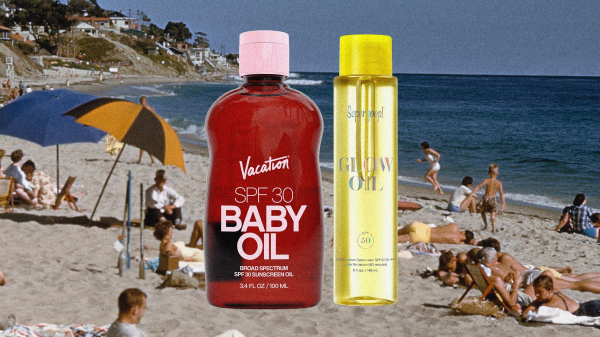
 Illustration by Allure; Photos courtesy of brands, Getty ImagesSave this storySave this story
When I was a teenager in the mid-2000s, my friends and I never used sunscreen. (Gasp, I know, but it was a different time—and my skin damage proves it.) Instead, we coated our bodies in layers of lotions and potions in pursuit of the perfect tan—including, of course, baby oil. Like generations of tanners before us, we were convinced the shiny oil would attract more UV rays for a deeper tan. A few years later, I did add some sun protection to my tanning routine… in the form of Banana Boat SPF 4 Dark Tanning Oil.
As increased education and advocacy for sun safety and responsible SPF usage became more prevalent, tanning oils seemed to fade into the background, relegated to a small space on the lowest big-box store shelf almost like a shameful little indulgence, replaced on the shelf by sporty sunscreen sprays and self-tanners.
So imagine my surprise when, a few years ago, I noticed brands launching oils—but not just any old tanning oils. No, these were rebranded and repackaged as sunscreen oils, boasting actual SPF protection and promising to make your skin look magazine-spread gorgeous.
For those of us who are reckoning with our youthful tanning exploits, however, the idea of wearing an oil formula in place of a cream or lotion seems like the antithesis of sun safety. (Anyone who got a blistering burn from baby oil will know what I mean.) I’ve used a few in the past and enjoyed the experience: the novelty of a baby oil-inspired SPF, the delicious smells, the shimmery, shiny glow it imparts on skin. But I was also curious about the kind of sun protection I was really getting from an oil—are these just tanning oils in a pretty disguise or can sunscreen oils genuinely compete with a gold-standard lotion?
The answer is, well, yes! With some caveats.
What to look for on a sunscreen oil label
According to Annette Czernik, MD, a board-certified dermatologist in Stamford, Connecticut, sunscreen oils can protect your skin just as well as a lotion formula—with one very important note: they must contain a real, broad-spectrum SPF of at least 30. (Sorry, younger self, that SPF 4 does not cut it, and neither does anything with an SPF 15.) You want to spend some time reading the label before making a purchase; look for “broad spectrum” front and center, which means a formula will protect skin against both UVA and UVB rays, she says. Though she generally prefers lotions or creams because they’re easier to apply on the skin and show where you may have missed a spot, she says that “the best sunscreen is the one you'll wear consistently and reapply as needed.”
Application is also key to ensuring you’re properly protected, Dr. Czernik adds. “Sunscreen oil needs to be spread into an even, generous layer over all exposed skin rather than lightly misted or rubbed on sparingly,” she advises. Let it sit for about 15 minutes before sun exposure so it can form a “protective film” and make sure you’re applying a lot of product. “The biggest mistake is assuming a thin, shiny layer is enough when it usually isn't,” Dr. Czernik says. If you’re using a spray oil, rub it in with your hands to make sure your skin is evenly covered, and don’t forget about what Dr. Czernik calls the “easy-to-miss areas, like the hairline, ears, and tops of the feet.”
Sunscreen oils may also wear off faster than their lotion and spray counterparts, especially if you’re swimming, sweating, or rubbing your skin dry with a towel, Dr. Czernik cautions, so they may need to be reapplied more often than the typically recommended two hours.
How sunscreen oils are formulated
From a formulation standpoint, sunscreen oils aren’t all that different from their spray and lotion peers. “Sunscreen oils are just sunscreens where the UV filters are delivered in an oil or, more commonly, an emollient-rich vehicle rather than the water-based emulsion or cream,” explains cosmetic chemist Kelly Dobos. “Many UV filters used in the U.S. are oil-soluble, so oils can actually be good vehicles for dissolving them.” Julian Sass, PhD, a cosmetic scientist, agrees, noting that the only major difference between an oil and a cream formula is the amount of water. “SPF oils are anhydrous, meaning no water,” he says. “But other than that, nothing is really different about them except for the format.”
According to Tiffany Mizell, head of global education at Supergoop, developing a quality sunscreen oil is a “balancing act between comfort and performance.” Shoppers want it all: an oil that feels lightweight, not greasy or heavy; nourishes the skin; and adds a radiant glow, but it also has to deliver reliable protection, she says.
“One of the biggest challenges is ensuring the UV filters remain evenly distributed throughout the formula so every application provides consistent protection with the texture of an oil,” Mizell explains. “Ultimately, if a sunscreen doesn't feel good on your skin, people are much less likely to use it consistently, and consistency is what makes sunscreen effective.”
Because sunscreen is classified as a drug by the FDA, new formulas require pretty significant testing before they are approved for public use. Dobos says that sunscreen oils go through the same testing as cream formulas, but notes that oils are actually easier to spread on the test plates during UVA testing because of their thin nature; creams with high levels of zinc oxide and titanium dioxide can be difficult to spread. For actual SPF testing, the oil is then applied to “defined patches of skin on the back” of test subjects by trained specialists in a thin layer, ensuring it doesn’t run down the skin.
Is there such a thing as natural sunscreen oil?
There has been some misinformation about oils and sun protection, however. Caren Campbell, MD, a board-certified dermatologist in San Francisco, says that while commercial sunscreen oils with FDA-approved filters “can absolutely provide effective sun protection when they're formulated and applied correctly,” alternative sunscreens made primarily from plant oils like coconut, carrot seed, or raspberry seed that claim to be a “natural” sunscreen oil do not provide adequate sun protection, no matter what TikTok may tell you. “Multiple studies have shown these oils have SPF values around 1 to 3, far below the recommended SPF 30, so they should never be considered a sunscreen substitute,” she says. A recent study found that several “natural” sunscreen alternatives promising to impart an SPF of 25 to 50 failed to live up to their claims.
Sunscreen oils and the return of tanning
When reporting about the uptick in youthful tanning, especially of the outdoor variety, we noticed that some young tanners would first apply their favorite tan enhancing, non-SPF products to their skin and then apply a layer of sunscreen—typically oil—atop. We were curious: does layering like this offer sun protection or do the formulas counteract one another? Though tanning enhancers without SPF are bad, layering a sunscreen oil with SPF on the top is a smart step. According to Dr. Sass, “if an SPF oil is applied, then you're getting all of the benefits of the SPF product and likely that will counteract any ‘tan boosting’ benefit of a tanning product, as the SPF product will be taking the brunt from any UV radiation,” he explains.
And on that note, the popularity of sunscreen oils seems to align perfectly with the return to tanning culture; though they are protecting your skin (if you’re using the right formula, of course), it still feels more like a laying-out ritual than one of sun protection. Dobos also points to the makeup-ification of sunscreen. “The biggest thing I notice is how heavily [sunscreen oils] are marketed around skin appearance,” she says. “Many newer sunscreen oils are designed to create a luminous finish with pearlescent pigments. From a formulation standpoint, they're an interesting hybrid between a sunscreen and cosmetic body product.” But do they also lull users into a false sense of security about sun safety? They feel good, smell good, and make your skin look great, but do they also subconsciously encourage you to stay in the sun just a little longer since you’re “protected?”
That depends on your relationship to the sunshine and your sun safety practices in general. As Sanam Hafeez, PhD, a neuropsychologist and director of Comprehend the Mind in New York, “people naturally look for information that supports what they already want to do. If someone enjoys being in the sun, wearing sunscreen oil can make it easier to justify staying outside because they feel they've ‘done the responsible thing,’” she explains. Imagine how you feel on vacation or at the beach; it feels great, which is why you stay out longer, right? “Sunscreen oil can become part of that carefree beach mindset, making it easier to focus on relaxation than on UV damage,” Dr. Hafeez continues. “Once people feel protected, they often stop thinking about the need to reapply, wear a hat, or take shade breaks. This doesn't mean sunscreen oils are unsafe, but they can influence behavior in subtle ways because of how our brains perceive comfort and protection.” In short, you may be more likely to take “small risks” if you feel like you’ve applied your sunscreen and can go on with your day. (Of course, this isn’t limited to just an oil sunscreen; the same thought process would apply to any sunscreen formula.)
And what about the reflectivity factor that my friends and I so wholeheartedly believed back in our Britney-blasting, Diet Coke-sipping, sunbathing days? According to Dr. Sass, it’s a bit of a tanning urban legend. “Oils have something called a refractive index, which measures how a product reflects light and how ‘shiny’ it is, and it isn't related to their ability to enhance a tan,” he explains. Shimmer and sparkle in your SPF are fine, though, says Mizell. “I actually think finishes like glow or shimmer can encourage people to wear sunscreen more consistently because they enjoy how it looks on their skin,” she explains. “If adding a little radiance makes someone excited to apply SPF every day, that's a positive thing!”